Ottawa Knee Rule
Sensitive; rules out imaging in some.
id
368
full_title
Ottawa Knee Rule
short_title
Ottawa Knee Rule
med_description
Describes criteria for knee trauma patients so low risk as not to warrant knee imaging.
description
The Ottawa Knee Rule describes criteria for minor knee trauma patients that are so low risk as not to warrant knee imaging.
keywords
r/o knee fx, rule out knee, ottawa knee, knee X-ray calc, knee XR, knee XR rules, acute knee rule, knee imaging rule, Acute knee imaging
complaint
[ "Extremity Pain", "Injury/Trauma" ]
formula
Series of Yes/No questions. See criteria below.
evidence
- Original derivation study by Stiell et al. was done in 1995 and included non-pregnant patients over age 18 who presented to Ottawa Civic and General Hospitals with a new injury <7 days old as a result of acute blunt trauma to the knee. Study enrolled 1,054 subjects, of whom 68 had fractures, 66 of them deemed to be clinically significant (not simple avulsion fragment <5 mm in breadth without associated complete tendon or ligament disruption). Using recursive-partitioning techniques, authors derived the five variables of their decision rule. If applied to the study population, their decision rule had sensitivity of 100% and specificity of 54% for identifying fractures and would lead to a 28% relative reduction in x-ray utilization.
- Stiell et al. then prospectively validated their decision rule in the same patient population. They performed telephone follow-up 14 days after the ED visit to determine the possibility of a missed fracture. Sensitivity of the decision rule was again 100%, identifying 63 clinically important fractures out of 1096 patients. Specificity was similar to the derivation study, at 49%, and they also found a 28% relative reduction in x-ray utilization.
- Stiell et al. prospectively implemented the decision rule in different teaching and community emergency departments. They found a relative reduction in x-ray usage of 26.4% while maintaining a sensitivity of 100% for detecting 58 knee fractures out of 3907 patients and a specificity of 48%. Moreover, there was a significant reduction in time to discharge and total medical charges in those patients who did not get an x-ray.
- The Ottawa Knee Rules have also been prospectively validated in populations outside of Canada. Two studies, one done in Spain and another in the United States, found that the Ottawa Knee Rules had a sensitivity of 100% and 98%, specificity of 52% and 19%, and a reduction in x-ray usage by 49% and 17%.
- These rules were applied to children aged 2 to 16 years of age in a prospective, multicenter validation study in 2003. That study found the decision rule to be 100% sensitive in finding 70 fractures out of 750 children, with a specificity of 42.8% and a potential reduction in x-ray usage by 31.2%.
- The Ottawa Knee Rules have also been compared to the
Pittsburgh Knee Rules , another well-validated clinical decision rule. A cross-sectional comparison of the two rules showed that both had sensitivities of 86% though thePittsburgh Knee Rules were significantly more specific. However, this study only included patients aged 18-79 and excluded pediatric patients.
measurements
[]
information
- A knee x-ray series is only required for knee injury patients with any of these findings:
- Age ≥ 55, OR
- Isolated tenderness of patella (no bone tenderness of knee other than patella), OR
- Tenderness of head of fibula, OR
- Inability to flex to 90°, OR
- Inability to bear weight both immediately after injury and in the ED for 4 steps (unable to transfer weight twice onto each lower limb regardless of limping.
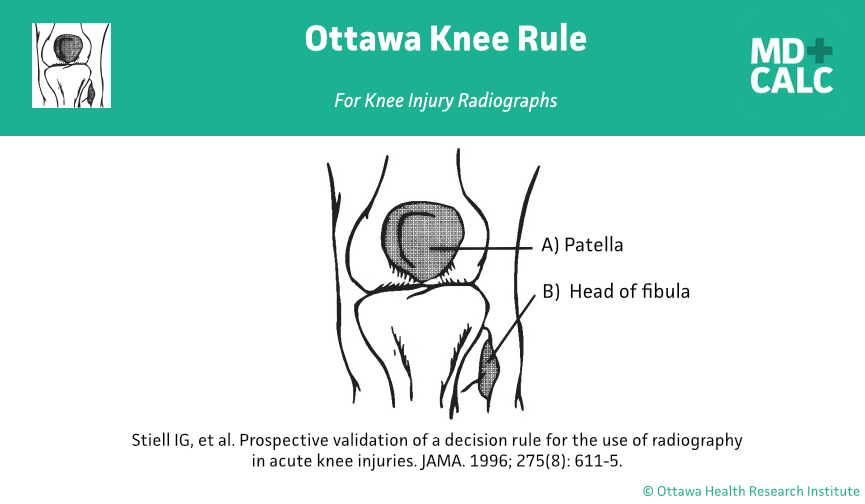
refrences
{ "Clinical Practice Guidelines": [ { "href": "", "text": "" } ], "Manufacturer Website": [ { "href": "", "text": "" } ], "Original/Primary Reference": [ { "href": "https://www.ncbi.nlm.nih.gov/pubmed/7574120", "text": "Stiell IG, et al. Derivation of a decision rule for the use of radiography in acute knee injuries. Annals of Emergency Medicine. 1995; 26(10): 405-13." } ], "Other References": [ { "href": "https://www.ncbi.nlm.nih.gov/pubmed/9403421", "text": "Stiell IG, et al. Implementation of the Ottawa knee rule for the use of radiography in acute knee injuries. JAMA. 1997; 278(23): 2075-9." }, { "href": "https://www.ncbi.nlm.nih.gov/pubmed/14734335", "text": " Bachmann L M, Haberzeth S, Steurer J, ter Riet G. The accuracy of the Ottawa knee rule to rule out knee fractures. Annals of Internal Medicine 2004; 140(2): 121-124." }, { "href": "https://www.ncbi.nlm.nih.gov/pubmed/10499943", "text": "Nichol G, Stiell IG, Wells GA, Juergensen LS, Laupacis A. An economic analysis of the Ottawa knee rule.Ann Emerg Med. 1999 Oct;34(4 Pt 1):438-47." }, { "href": "https://www.annemergmed.com/article/S0196-0644%2899%2970404-X/abstract", "text": "Stiell IG, Wells GA, McKnight RD. Validating the “Real” Ottawa Knee Rule. Ann Emerg Med 1999;33:241-243." }, { "href": "https://www.ncbi.nlm.nih.gov/pubmed/10587149", "text": "Tigges S, et al. External validation of the Ottawa knee rules in an urban trauma center in the United States. American Journal of Roentgenology. 1999; 172:1069-71." }, { "href": "https://www.ncbi.nlm.nih.gov/pubmed/12827123", "text": "Bulloch B, et al. Validation of the Ottawa knee rule in children: A multicenter study. Annals of Emergency Medicine. 2003; 42(7): 48-55." }, { "href": "https://www.ncbi.nlm.nih.gov/pubmed/23399332", "text": "Cheung TC, et al. Diagnostic accuracy and reproducibility of the Ottawa knee rule vs the Pittsburgh decision rule. 2013; 31: 641-5." } ], "Outcomes": [ { "href": "", "text": "" } ], "Validation": [ { "href": "https://www.ncbi.nlm.nih.gov/pubmed/8594242", "text": "Stiell IG, et al. Prospective validation of a decision rule for the use of radiography in acute knee injuries. JAMA. 1996; 275(8): 611-5." }, { "href": "https://www.ncbi.nlm.nih.gov/pubmed/11574791", "text": "Emparanza JI and Aginaga JR. Validation of the Ottawa knee rules. Annals of Emergency Medicine. 2001; 38(10):364-8." } ], "Validations": [] }
pearls
The Ottawa Knee Rules were derived to aid in the efficient use of radiography in acute knee injuries.
- Rules have been prospectively validated on multiple occasions in different populations and in both children and adults.
- Numerous studies found sensitivities for the Ottawa Knee Rules of 98-100% for clinically significant knee fractures. One study did find a sensitivity of just 86%.
- Specificities for the Ottawa Knee Rules typically range from 19%-50%, though the rule is not designed/intended for specific diagnosis.
- When used appropriately, the amount of knee x-rays obtained can be reduced by around 20-30%.
- The Ottawa Knee Rules are useful in ruling out fracture (high sensitivity) when negative, but poor for ruling in fractures (many false positives).
Tips from the creators at University of Ottawa:
- Tenderness of patella is significant only if an isolated finding.
- Use only for injuries <7 days.
- “Bearing weight” counts even if the patient limps.
Precautions from the creators at University of Ottawa:
- Clinical judgment should prevail if examination is ureliable:
- Intoxication.
- Uncooperative patient.
- Distracting painful injuries.
- Diminished sensation in legs.
- Always provide written instructions.
- Encourage follow-up in 5-7 days if pain and ability to walk is not better.
usecase
The Ottawa Knee Rules should be applied to all patients aged 2 and older with knee pain/tenderness in the setting of trauma.
reasons
Patients without criteria for imaging by the Ottawa Knee Rules are highly unlikely to have a clinically significant fracture and do not need plain radiographs. Application of the Ottawa Knee Rules can cut down on the number of unnecessary radiographs by 20-30%, which has proven to be cost effective for patients without reducing quality of care. (Nichol 1999)
next_advice
Patients who do not have any of the Ottawa Knee Rules present do not need an x-ray. If one or more of the conditions are met, then x-ray is recommended.
next_actions
Patients who do not have any of the Ottawa Knee Rules present do not need an x-ray. If one or more of the conditions are met, then x-ray is recommended.
Many experts would consider this score “one directional.” Because the rule is sensitive and not specific, it provides a clear guide of which patients not to x-ray if all criteria are met. However if a patient fails the criteria, need for x-ray can be left to clinical judgement.
next_management
For significant non-bony injuries, often crutches and a knee immobilizer can be helpful to assist with ambulation.
diseases
[ "Fracture", "Sprain/Strain", "Trauma" ]
instructions
published
2022-04-21T20:29:18.766Z
purpose
[ "Diagnosis", "Rule Out" ]
search_terms
[ "ortho", "knee" ]
seo
{ "keywords_en": "r/o knee fx, rule out knee, ottawa knee, knee X-ray calc, knee XR, knee XR rules, acute knee rule, knee imaging rule, Acute knee imaging", "meta_description_en": "The Ottawa Knee Rule describes criteria for minor knee trauma patients that are so low risk as not to warrant knee imaging." }
specialty
[ "Emergency Medicine", "Family Practice", "Internal Medicine", "Orthopedics", "Primary Care", "Surgery (Trauma)" ]
departments
[ "Musculoskeletal" ]
tags
[]
version_number
1
versions
[]
related
[ { "calcId": 1670, "short_title_en": "Ottawa Ankle Rule", "slug": "ottawa-ankle-rule" }, { "calcId": 1042, "short_title_en": "Pittsburgh Knee Rules", "slug": "pittsburgh-knee-rules" }, { "calcId": 10085, "short_title_en": "SLICS", "slug": "subaxial-injury-classification-severity-scale-slics" } ]
ismed
true
section
[ "whenToUseViewed", "pearlsPitfallsViewed", "whyUseViewed", "nextStepsViewed", "evidenceViewed" ]
cleaned_departments
[ "orthopedics" ]
cleaned_use
[ "The Ottawa Knee Rules should be applied to all patients aged 2 and older with knee pain/tenderness in the setting of trauma." ]
pub
true