Parkland Formula for Burns
Fluid requirements after burns.
id
83
full_title
Parkland Formula for Burns
short_title
Parkland Formula for Burns
med_description
Calculates fluid requirements for burn patients in a 24-hour period.
description
Calculates fluid requirements for burn patients in a 24-hour period.
keywords
Parkland Formula for Burns, parkland formula, parkland burns, parkland score, parkland calc, parkland mdcalc, parkland online, parkland calculate, burn calc, burn score, burn calc, burn formula, burn parkland, burn score, percent of body burned, % body burned, % of body burned, fluid requirements burn, fluid burn, fluid burn, fluid needed, 24 fluid requirement, 24 hour fluid requirement, 24 hour parkland, 24 hour parkland formula, fluid 24 hours parkland, parkland fluid, parkland formula, rule of 9s, rule of 9, 9% burn, 18% burn, rule of 9 burn, rule of fluids for burn, fluid rule for burn, fluid s/p burn, parkland fluid burn, parkland fluid post burn, parkland formula burn, bsa burn, tbsa burn, tbsa burn treatment, burns fluid replenish, 8 hours post burn, 16 hours post burn, 8 hrs fluid burn, 16 hrs fluid burn
complaint
[ "Injury/Trauma" ]
formula
Fluid Requirements = TBSA burned(%) ×Wt (kg) ×4 mL
evidence
Resuscitation Formula:
- The Parkland Formula is a validated and effective approach to initial fluid resuscitation in the acutely burned patient (Baxter 1974, Cartotto 2002, Blumetti 2008).
- It was developed by Dr. Charles Baxter at Parkland Memorial Hospital in Dallas, Texas.
measurements
[ { "name": "Weight", "unit": "wt", "error_min": "0.5", "error_max": "620", "warn_min": "0.5", "warn_max": "500", "conversion": "0.453592", "normal_max_si": "150", "normal_max_us": "330", "normal_min_si": "1", "normal_min_us": "2", "units_si": "kg", "units_us": "lbs" }, { "name": "% Neutrophils", "unit": "neut", "error_min": "-0.01", "error_max": "100.01", "warn_min": "35", "warn_max": "100", "conversion": "1", "normal_max_si": "0", "normal_max_us": "0", "normal_min_si": "0", "normal_min_us": "0", "units_si": "%", "units_us": "%" } ]
information
Administration of fluids:
- Give 1/2 of total requirements in 1st 8 hours (time from when the burn occurred), then give 2nd half over next 16 hours.
Wallace
- A quick, easy-to-use estimation of TBSA, which is helpful for emergency situations where rapid assessment is required.
- For adults: 9% for each arm, 18% for each leg, 9% for head, 18% for front torso, 18% for back torso.
- For children: 9% for each arm, 14% for each leg, 18% for head, 18% for front torso, 18% for back torso.
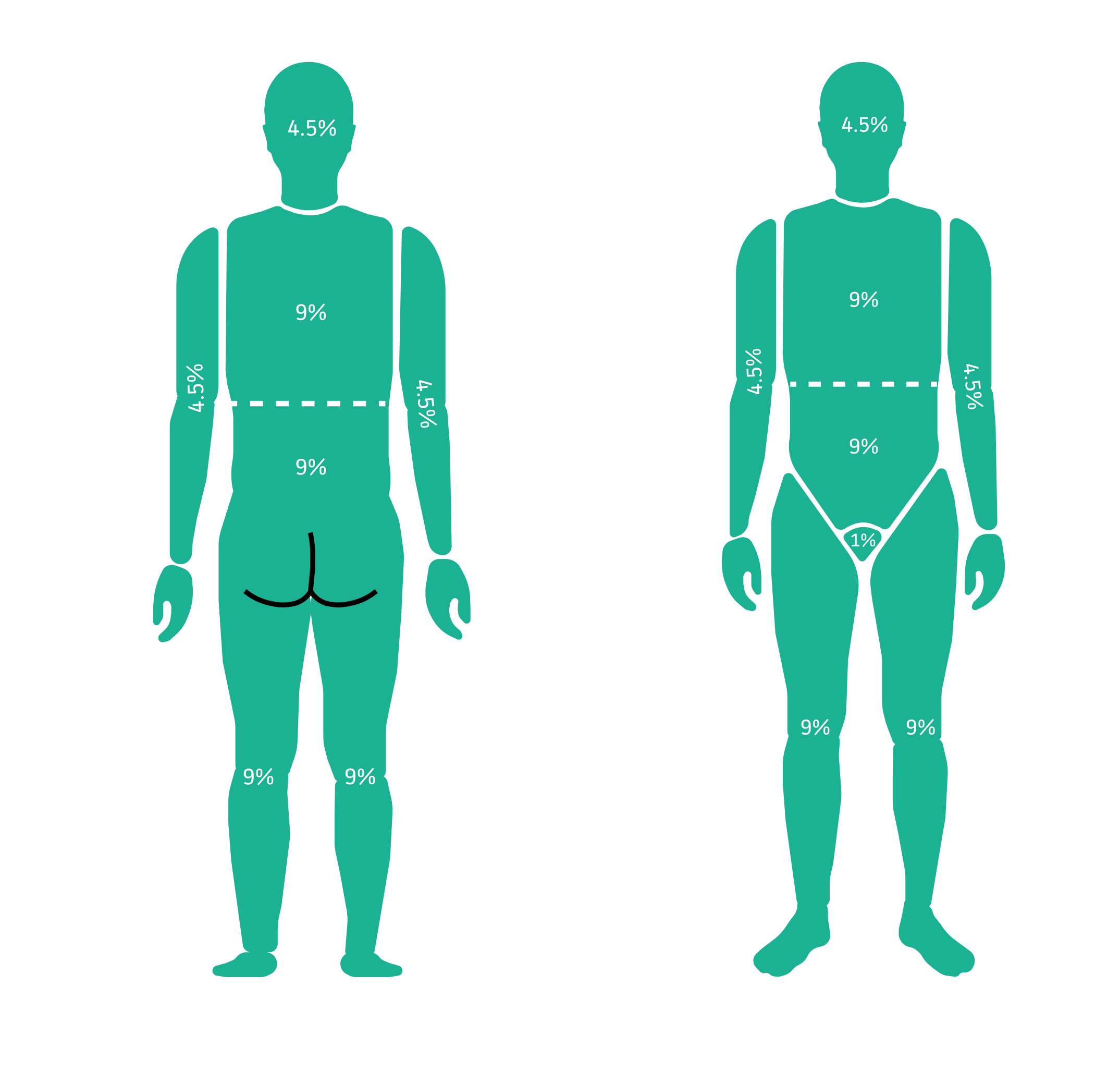
Lund and Browder Chart:
- More accurate and better accounts for differences in body proportions between children and adults.
- Not as easy to use as the rule of 9s, and may be used as a follow-up estimation of TBSA once a patient is stabilized.

refrences
{ "Clinical Practice Guidelines": [ { "href": "", "text": "" } ], "Manufacturer Website": [ { "href": "", "text": "" } ], "Original/Primary Reference": [ { "href": "https://www.ncbi.nlm.nih.gov/pubmed/4609676", "text": "Baxter CR. Fluid volume and electrolyte changes in the early post-burn period. Clin Plast Surg 1974;1:693–703." } ], "Other References": [ { "href": "https://www.ncbi.nlm.nih.gov/pubmed/18182919", "text": "Blumetti J, et. al. The Parkland Formula Under Fire: Is the Criticism Justified? J Burn Care Res. 2008 Jan-Feb;29(1):180-6." }, { "href": "https://www.ameriburn.org", "text": "American Burn Association Guideline. Available at: http://www.ameriburn.org." }, { "href": "https://www.ncbi.nlm.nih.gov/pubmed/15062415", "text": "Ahrns KS. Trends in burn resuscitation: Shifting the focus from fluids to adequate endpoint monitoring, edema control, and adjuvant therapies. Crit Care Nurs Clin N Am 2004; 16:75–98" }, { "href": "https://www.ncbi.nlm.nih.gov/pubmed/10347386", "text": "Ahrns KS, Harkins DR. Initial resuscitation after burn injury: Therapies, strategies, and controversies. AACN Clin Issue 1999; 10:46–60" }, { "href": "https://www.ncbi.nlm.nih.gov/pubmed/11900940", "text": "Jeng JC, Jablonski K, Bridgeman A, et al. Serum lactate, not base deficit, rapidly predicts survival after major burns. Burns 2002; 28:161–166" } ], "Outcomes": [ { "href": "", "text": "" } ], "Validation": [ { "href": "https://www.researchgate.net/publication/11238742_How_well_does_the_Parkland_formula_estimate_actual_fluid_resuscitation_volumes", "text": "Cartotto RC, et. al. How Well Does The Parkland Formula Estimate Actual Fluid Resuscitation Volumes? Journal of Burn Care & Rehabilitation. 2002. Volume 23, Number 4. DOI: 10.1097/01.BCR.0000020449.78548.E0." } ], "Validations": [] }
pearls
- The Parkland Formula is a validated and effective approach to initial fluid resuscitation in the acutely burned patient.
- Overly aggressive fluid resuscitation, termed “fluid creep”, is well documented in critical care literature. Factors that may lead to fluid creep include lack of physician observation of endpoints (i.e. urine output), increased opioid use and the emergency nature of goal-directed resuscitation.
- Patients with inhalational and electrical burns, as well as children and the elderly, may require more or less fluid resuscitation than is predicted by the formula.
usecase
Patients with acute burns.
reasons
The Parkland Formula has been endorsed by the American Burn Association. It has been shown to appropriately restore intravascular volume and limit the development of hypovolemic shock.
next_advice
It is important to remember that all resuscitation formulas be used as a guide. Patients should be assessed frequently, with individual adjustments made to maintain adequate organ perfusion.
next_actions
Critically ill burn patients are best cared for at a dedicated burn center, particularly those with any of the following:
- >10% TBSA partial thickness burns.
- Any size full-thickness burn.
- Burns to hands or genitals.
- Inhalation injury.
- Serious chemical injury.
- Serious electrical injuries, including lightning.
next_management
Resuscitation endpoints and monitoring:
- Urine output: 0.5 mL/kg/hr urine output in adults (50-100cc/hr) and 0.5–1.0 mL/kg/hr in children <30 kg.
- Heart rate: HR<110 in adults usually indicates adequate volume. Narrowed pulse pressure provides an earlier indication of shock than does systolic blood pressure alone.
- Monitoring blood pressure by arterial catheter is superior to cuff pressures because of interference of tissue edema. Radial artery is the first choice, followed by femoral artery.
- Serum lactate is a strong predictor of mortality, and trends can be utilized to determine hemostatic status however, it should not be used as an independent predictor of adequate fluid resuscitation.
diseases
[ "Burns", "Trauma" ]
instructions
Use in adult patients with burns. Children have larger TBSA relative to weight and may require larger fluid volumes.
published
2022-04-21T20:29:47.612Z
purpose
[ "Treatment" ]
search_terms
[ "fluid requirements ", "parkland", "fluids", "burn", "prognosis", "24 hour", "% of body" ]
seo
{ "keywords_en": "Parkland Formula for Burns, parkland formula, parkland burns, parkland score, parkland calc, parkland mdcalc, parkland online, parkland calculate, burn calc, burn score, burn calc, burn formula, burn parkland, burn score, percent of body burned, % body burned, % of body burned, fluid requirements burn, fluid burn, fluid burn, fluid needed, 24 fluid requirement, 24 hour fluid requirement, 24 hour parkland, 24 hour parkland formula, fluid 24 hours parkland, parkland fluid, parkland formula, rule of 9s, rule of 9, 9% burn, 18% burn, rule of 9 burn, rule of fluids for burn, fluid rule for burn, fluid s/p burn, parkland fluid burn, parkland fluid post burn, parkland formula burn, bsa burn, tbsa burn, tbsa burn treatment, burns fluid replenish, 8 hours post burn, 16 hours post burn, 8 hrs fluid burn, 16 hrs fluid burn", "meta_description_en": "Calculates fluid requirements for burn patients in a 24-hour period." }
specialty
[ "Critical Care", "Critical Care (Pediatric)", "Emergency Medicine", "Hospitalist Medicine", "Internal Medicine", "Surgery (General)", "Surgery (Trauma)" ]
departments
[ "Musculoskeletal" ]
tags
[]
version_number
1
versions
[]
related
[ { "calcId": 10568, "short_title_en": "Rule of Nines", "slug": "rule-nines" }, { "calcId": 10189, "short_title_en": "Body Fluid Balance Calculator", "slug": "body-fluid-balance-calculator-inputs-outputs" }, { "calcId": 10085, "short_title_en": "SLICS", "slug": "subaxial-injury-classification-severity-scale-slics" } ]
ismed
true
section
[ "whenToUseViewed", "pearlsPitfallsViewed", "whyUseViewed", "nextStepsViewed", "evidenceViewed" ]
cleaned_departments
[ "orthopedics" ]
cleaned_use
[ "Patients with acute burns." ]
pub
true